
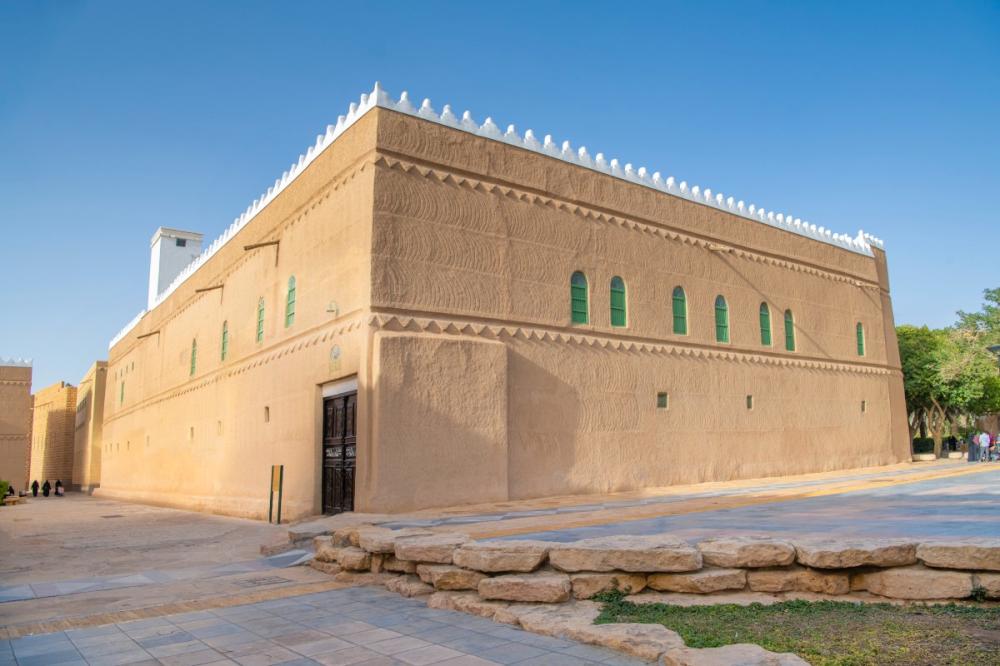
Al Murabba Palace… A Journey Through Riyadh’s Memory and Architectural History
Al Murabba Palace is considered one of the most prominent historical landmarks that adorn the city of Riyadh, the capital of the Kingdom of Saudi Arabia. This palace was constructed in the period preceding the unification of Saudi Arabia, outside the walls of old Riyadh, specifically in 1936, and its construction was a landmark event in the country’s history.
In this palace lived the founder of the Kingdom of Saudi Arabia, the late King Abdulaziz bin Abdulrahman Al Saud, from 1938 until his death in 1953, which gives it great historical value. It was given this name due to its square structure, which reflects a distinctive architectural design and vision.
Al Murabba Palace consists of two floors, designed in a traditional style harmonious with the character of the era at that time, as the construction combined deep-rooted heritage with simple engineering development that was on its way toward modernization.
King Abdulaziz moved to this palace after settling in Riyadh in 1938, in a pivotal step that followed the unification of Saudi Arabia which he led.
The palace served as the personal residence of King Abdulaziz, and within it were held pivotal historical meetings that led to strengthening his rule and unifying the lands of Saudi Arabia.
During that period, Al Murabba Palace witnessed the arrival of a number of kings, presidents, and diplomatic delegations, who were impressed by the beauty of the structure and the greatness of the idea behind its design.
At that time, this palace represented a residence for the King and a symbol of the development and construction witnessed by Saudi Arabia during that era. When people looked at the palace in its square form, they realized that it was not merely a building, but a reflection of a royal vision seeking to achieve modern renaissance.
Al Murabba Palace remains to this day a living witness to a pivotal phase in the history of Saudi Arabia. King Abdulaziz used it as a center for managing the affairs of governance, until it later became a historical museum that tells the world the story of the establishment and development that Saudi Arabia experienced.
Al Murabba Palace is distinguished by its construction using local materials, such as sun-dried mud bricks, in addition to solid foundations built from local stone. Circular stones were also used to build the columns that adorn the interior of the palace.
The decorations are not limited to the interior walls only, but extend to include the exterior walls as well, in addition to the geometric patterns that adorn the wooden elements surrounding the windows and doors, giving the palace an elegant architectural beauty that reflects the refined taste that prevailed during that era.