
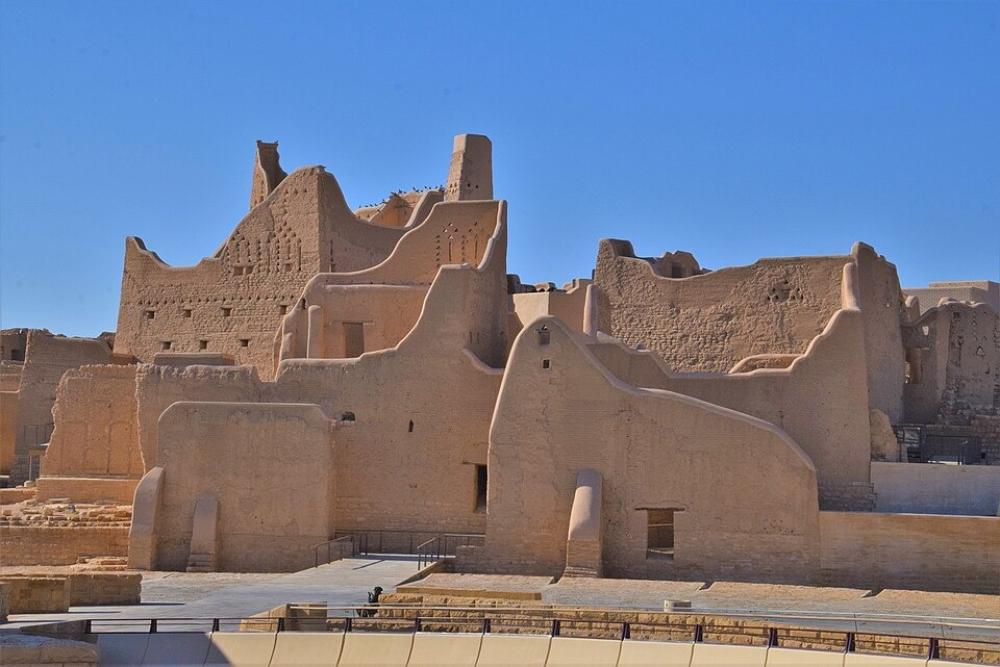
Salwa Palace… From a Seat of Power to a Museum Narrating the History of Saudi Arabia (Salwa Palace)
Salwa Palace, that historic archaeological palace standing proudly to the north of Diriyah, in the Riyadh region at the heart of Saudi Arabia, is a living witness to the greatness of this land’s history (Saudi museum).
Its construction dates back to the early eighteenth century, making it an integral part of Saudi Arabia’s identity and rich heritage. In 2010, the palace was inscribed on the UNESCO World Heritage List, reflecting its unique status among the world’s historical landmarks (the establishment of Salwa Palace during the Imam’s era).
Historically, Salwa Palace is considered the first home of the early founders of the First Saudi State, as it served as the seat of governance and the center of political decision-making during that period (Salwa Palace was established during the Imam’s era).
This archaeological palace, built in the At-Turaif District, extends over a vast area of approximately ten thousand square meters, giving it immense historical significance, as it was the headquarters that witnessed many decisive events in the journey of the First Saudi State (Salwa Palace was founded).
As for the reason behind naming it “Salwa Palace,” one narrative suggests a connection to the concept of “salwa,” which expresses comfort and tranquility within the palace, a place that played an important role in providing reassurance and leadership to Saudis at that time.
The palace went through several phases of development since its construction in the eighteenth century, evolving over seven successive stages, highlighting the importance of preserving this historical monument through the ages.
Salwa Palace consists of four floors and once housed a council where many important meetings were held, during which matters of religion and daily life were discussed. Among its corners is a small secret room known as “Al-Khazna,” which the Imam used with his advisors for matters requiring complete secrecy.
The palace is built in the northeastern part of the At-Turaif District and extends over a large area, bordered to the north by Wadi Hanifah and to the east by the Bayt Al-Mal. It was also part of the route of Abdullah bin Saud and the palaces of his sons and brothers, with historical remains located in the northwestern section as well (where is Salwa Palace located).
Salwa Palace is the largest palace in the city of Diriyah in the Najd region, covering an area exceeding ten thousand square meters. It consists of seven architectural units built in multiple phases since the era of Imam Muhammad bin Saud, the founder of the First Saudi State. Although much of the palace has deteriorated over time, what remains stands as a historical monument reflecting the spirit and heritage of the region (where is Salwa Palace situated).
Today, Salwa Palace is considered one of the most prominent tourist landmarks, housing the Diriyah Museum, which presents the history of the development of the Saudi state through artworks, drawings, models, and documentary films that shed light on this important era in Saudi Arabia’s history (Salwa Palace).