
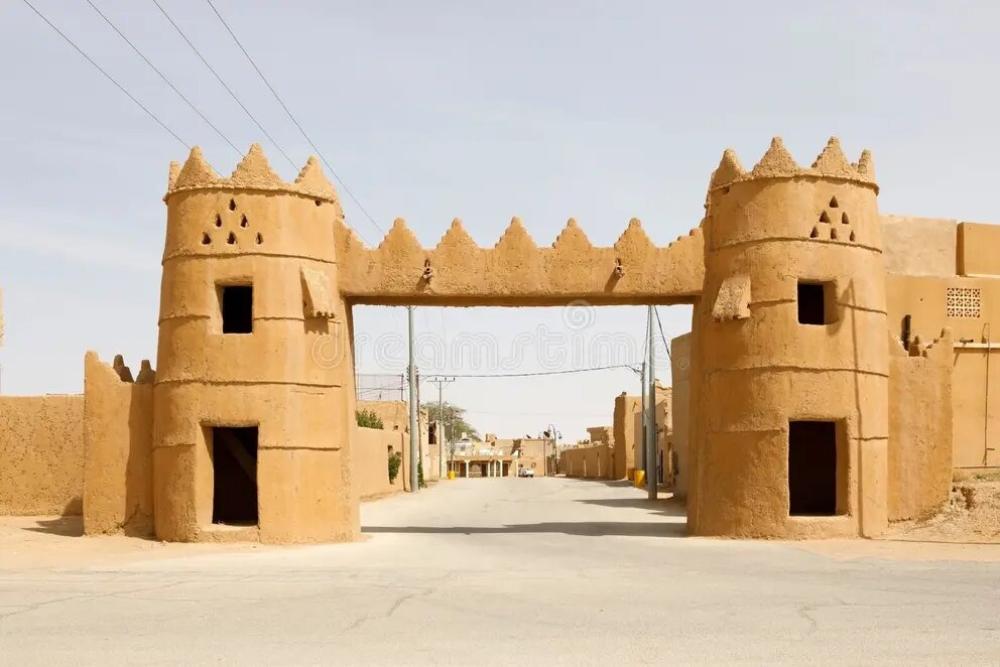
Al-Qasab Village .. The Food Basket of Al-Yamamah
Al-Qasab Village is located in the heart of Saudi Arabia, about 150 kilometers northwest of the capital Riyadh. It is one of the villages of the famous Al-Washm region, enjoying a distinguished location near the city of Shaqra, about 30 kilometers away.
Al-Hamawi mentioned in his book Al-Buldan that Al-Qasab is part of the historic land of Al-Yamamah. The prominent historian Mohammed bin Bilehid also referred to its location between “Al-Sha‘b” and “Al-Aqla,” explaining that it is one of the well-known villages of Al-Yamamah.
Al-Qasab was historically known as “Al-Qaseeb,” and it is said that most of its agricultural production focused on wheat.
If we determine its location more precisely, Al-Qasab lies at the intersection of longitude 45 degrees east and latitude 25 degrees north. The village sits on a flat land known as “Al-Kumaydiya,” surrounded by the mountains of “Suwaig” from the north, while the sands of “Sareef Al-Jabal,” also known as “Ramlah Al-Righam,” extend from the west and south.
Al-Qasab is also known for its view of “Anf Barak,” one of the most prominent peaks of the Suwaig mountains, also called “Al-Obalis.” Recent statistics indicate that its population exceeds 5,500 people.
Some historical studies mention that the origins of Al-Qasab date back to the pre-Islamic era, and that the name Al-Qasab appeared around the year 700 AH. It is also believed that the town had been a center of population attraction for hundreds of years due to its diverse natural resources such as salt, valleys, and mountain passes.
In ancient times, Arab villages relied on walls to protect their communities. Al-Qasab was surrounded by two walls: the first encircled the northeastern houses, while the other surrounded the town itself.
Historically, the residents of Al-Qasab lived in a community divided into two sections: Old Al-Qasab, characterized by its mud houses, and New Al-Qasab, which witnessed development over time. Some of the newer neighborhoods were known for their narrow alleys and winding streets, mainly due to the absence of organized urban planning that prevailed in that era.
Throughout the centuries, Al-Qasab became known as a productive agricultural center, particularly in the production of wheat and salt. It played an important role in food security in the region. Its production of “Rasmar salt,” known for its quality, became famous, and the product was often referred to as “white gold.”
Since ancient times, Al-Qasab contributed to supplying many cities and villages in Saudi Arabia with their salt needs. Its local exports even extended to Yemen and the Arabian Gulf countries. In the past, salt was transported on the backs of camels before transportation was later replaced by vehicles.
In a further development, the “Zad” salt refining factory was established in Al-Qasab. The factory uses the latest technologies and international standards to produce and package table salt in different sizes and high quality. Salt extraction processes have also improved significantly with the development of machinery. In the past, traditional extraction methods were difficult and required significant labor effort, but with the use of machines and pumps, costs decreased and salt production became easier and more efficient.